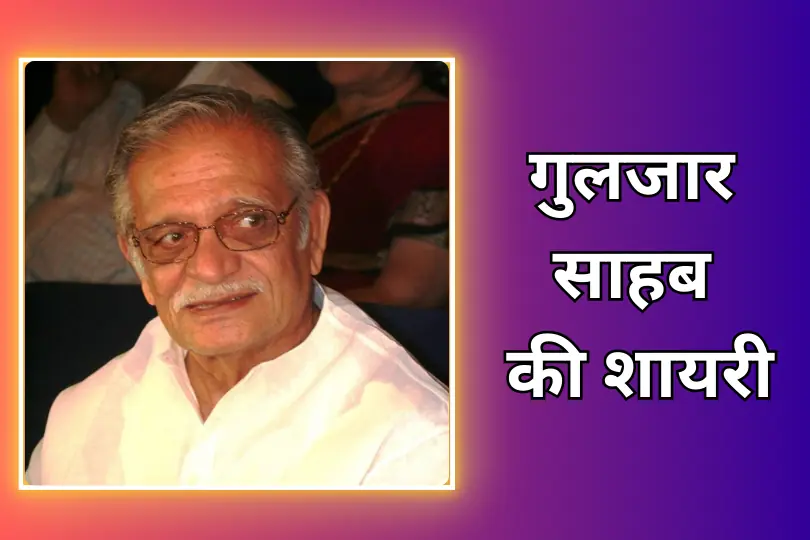
Gulzar, the name itself evokes an air of lyrical beauty, emotional depth, and timeless poetry. As one of India’s most celebrated poets, lyricists, and writers, Gulzar has gifted generations with words that stir the soul and speak the language of the heart. Whether it’s love, pain, nostalgia, or life itself, his shayari captures the essence of human emotions with extraordinary finesse. His words are not just poetic lines; they are reflections of feelings many struggle to express.
In this article, we will explore fifty of his finest shayaris that have touched countless hearts and continue to resonate with audiences across all ages.
One of the most remarkable aspects of Gulzar’s poetry is its simplicity. He doesn’t rely on complicated metaphors or dense vocabulary to convey his feelings. Instead, he opts for clear, heartfelt expressions that echo in the reader’s mind long after the lines have been read. For instance, one of his most famous verses goes, “Dil dhoondta hai phir wahi fursat ke raat din,” a line that speaks volumes about longing and the irretrievable beauty of the past.
Another feature of Gulzar’s shayari is his profound understanding of human relationships. His poems often delve into the intricacies of love, not just the bliss but also the heartbreak, confusion, and quiet companionship it brings. One such line that captures the subtle pain of separation is, “Chhod aaye hum woh galiyan,” which encapsulates the feeling of leaving behind not just a place but a piece of oneself.
His work beautifully touches on themes of silence and unspoken words, as seen in, “Kuch na kaho, kuch bhi na kaho,” a line that reveals how sometimes silence can convey more than a thousand words. His style is evocative, intimate, and deeply personal, and it’s this quiet intensity that makes his poetry so enduring.
Gulzar’s shayari often explores the idea of time — its passage, its cruelty, and its beauty. Lines like “Shaam se aankh mein nami si hai, aaj phir aapki kami si hai” highlight how the memory of someone can invade the stillness of evening, making it both beautiful and melancholic at once. His use of nature — rain, wind, seasons — adds another layer to the emotional richness of his verses.
The poet’s ability to blend pain and beauty is remarkable. In one of his lines, he writes, “Tujhse naraz nahi zindagi, hairaan hoon main,” where life itself is a companion that confuses and surprises rather than angers. It’s this nuanced portrayal of life’s unpredictability that many find solace in. His verses do not offer easy answers but rather present emotions as they are, raw and unfiltered.
Many of Gulzar’s shayaris are about longing — for a lover, a moment, or a time long gone. His poetry touches the pulse of nostalgia. In a line like, “Woh afsana jise anjaam tak laana na ho mumkin, use ek khoobsurat mod dekar chhodna achha,” there’s wisdom in accepting incomplete love stories. He teaches that there’s beauty in imperfection, and sometimes letting go with grace is more poetic than holding on.
His verses also speak of the unseen and the unheard — the gestures that go unnoticed, the emotions that are felt but not spoken. In “Roz kehti ho chhod dunga main, aaj keh do toh sach mein chhod doon,” there’s a quiet desperation, a plea that’s barely voiced yet deeply felt. This undercurrent of vulnerability runs through much of his poetry, making it incredibly relatable.
Another recurring theme in Gulzar’s shayari is the passage of love from passion to companionship. His poetry often reflects how relationships evolve over time. Lines like, “Ek lamha tha, hum mile the kabhi, ab toh bas yaadein hi saathi hain,” are steeped in the essence of time and how it transforms even the most intense love into memory.
His words are also laden with the scent of everyday life. He romanticizes the mundane, making tea, rain, or even traffic signals a metaphor for life and emotion. In one of his beautiful lines, he says, “Barish ki kuch boondein kya giri, yaadon ka silsila sa chalu ho gaya,” turning a simple drizzle into a doorway to nostalgia.
It is this magical ability to find poetry in the ordinary that makes Gulzar’s work so special. His shayari doesn’t just express; it connects. It touches people because it feels like something they could have written, if only they had the words.
Gulzar is also a master of minimalism. His short couplets often carry the weight of entire stories. For example, “Usne kaha tumse kuch nahi ho payega, aur main ro pada,” is just a few words, but they strike hard. They hold within them failure, rejection, helplessness — all wrapped in simple language.
Even when his lines are cryptic, they are never confusing. They invite the reader to sit with them, mull them over, and extract their own meaning. This is one reason his work remains timeless — it grows with the reader, revealing new facets every time it is revisited.
His poetry transcends generations Gulzar Shayari. Young people discovering love for the first time, as well as older readers reminiscing about days gone by, all find something personal in his verses. Gulzar’s words feel like home, a familiar whisper in an unfamiliar world.
His shayari also often talks about solitude — not as something to fear but as something to embrace. He finds peace in being alone, in the quiet corners of one’s own mind. Lines like “Tanha tanha mat socha kar, log tere saath bhi tanha hain,” offer a strange kind of comfort to those struggling with loneliness.
There’s also a quiet rebellion in some of his poetry, a desire to break free from societal expectations, norms, and masks. He doesn’t scream against injustice; he whispers, making his dissent even more powerful.
Gulzar’s legacy lies not just in the words he wrote, but in the silences between them. He understands that sometimes what’s left unsaid speaks the loudest. And perhaps that is why his poetry continues to echo in hearts, across decades.
In conclusion, the top 50 shayari by Gulzar cannot simply be listed like items on a chart. They must be experienced, felt, lived. His words are not just poetry; they are emotional experiences. They remind us of who we are, what we have loved, what we have lost, and what we still hope for. Gulzar doesn’t just write verses — he writes feelings. And that is what makes his shayari unforgettable.